



 Plan an unforgettable day !
 The Pacific Ocean is a realm of oceanic migration, governed through the ages by currents and celestial bodies. Through an immersive and poetic multimedia show, witness the dispersal of reef eggs and larvae. This dreamlike experience, which starts the tour, transcends the purely scientific realm to spark your imagination and whisk you away on a journey to explore tropical marine biodiversity.
Opening of Océanopolis’s new Tropical Pavilion

Océanopolis’s Tropical Pavilion reopens on July 4 2026, following its renovation as part of the Metamorphosis project. Discover the new features of this major transformation, designed to offer a decidedly more sensorial and spectacular visitor experience.
Published on 21/07/2026.
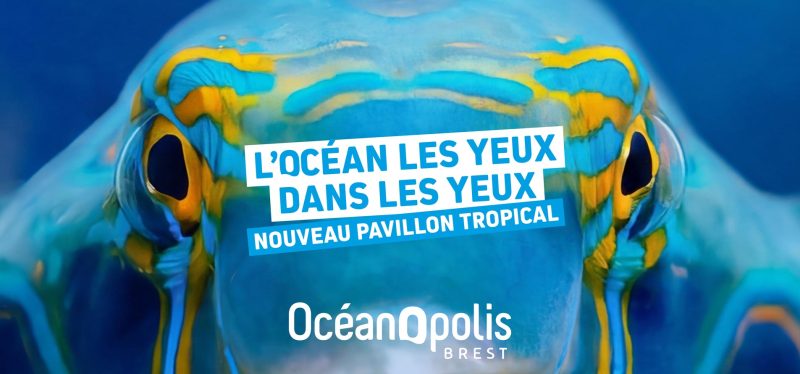
Océanopolis’s Tropical Pavilion reopens on Saturday July 4 2026
After being closed for nearly two years for renovations, Océanopolis’s Tropical Pavilion reopens its doors on Saturday July 4 2026. The reopening marks the culmination of a major transformation as part of the Metamorphosis project, offering a completely renewed experience based on tropical marine biodiversity.
What has changed?
Updated museography
The new design of the Tropical Pavilion focuses on multisensory immersion. Through innovative interactive features, visitors become active participants in the discovery process.
Reimagined spaces
- A new experiential, seamless and intuitive visitor route
- Enlarged windows, including an impressive 28m² curved panoramic view
- Fresh perspectives, thanks to the addition of walkways and commanding viewpoints
- Immersive scenography combining projections, soundscapes and tactile elements
Enriched collections
The pavilion now houses more exceptional specimens, such as a reconstructed 2.85 metre megalodon jaw, a spectacular testament to the evolution of sharks through the ages.
Fresh pedagogical approach
The collecting spirit of museums has been combined with sensory exploration to offer multiple levels of interpretation, suited to all audiences and learning styles.
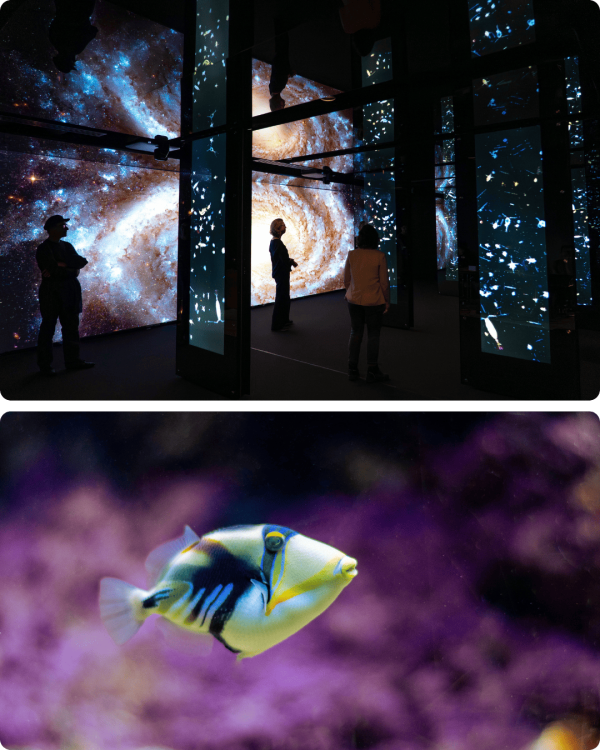
4 new features in the Tropical Pavilion
Pacific odysseys 

The lagoon
Following the immersive show, discover the lagoon, a coral reef cove.
The lagoon is a very shallow, light-filled environment and is home to corals that live in symbiosis with zooxanthellae algae. Through photosynthesis, the algae provide a large proportion of these corals’ nutrition.
In this pool, which can be viewed from above, you can admire:
- Corals
- Dozens of giant clams. These giant bivalve molluscs are spectacular not only for their size but also for their brilliant colours.
- Tropical fish
This space is accompanied by an audio story written by David Wahl, artist in residence at Océanopolis, about the mysterious palolo worm and its ancestral relationship with the peoples of the Pacific.
Shoal life
A brand-new cylindrical tank, measuring 3 metres in both diameter and height, offers visitors a spectacular view of shoal life over the sandy seabeds found at the foot of coral reefs. Here you can find several species there that are rarely displayed in aquariums:
- A colony of more than 200 garden eels (Heteroconger hassi)
- Shoals of razorfish (Aeoliscus strigatus)
- Brightly coloured corals (Tubastrea spp.) and black coral colonies (Cirrhipathes spiralis)
- A shoal of several hundred Waite’s splitfin (Luzonichthys waitei)
This new aquarium, with much more subdued light, gives an overview of the richness of the deep mesophotic reefs. These environments, found at depths of between 40 and 200 metres, have long been poorly understood by the scientific community.
Scientific carbet
Located at the end of the visitor trail, in the heart of Océanopolis’s tropical greenhouse, is a brand-new feature called the scientific carbet, allowing visitors to discover the living conditions experienced by scientists during their field work.
Carbets are communal wooden shelters, either open or semi-open, widespread in French Guiana and throughout the Caribbean. These traditional Amerindian structures inspired CNRS to establish a vast research station in French Guiana, in the heart of the Nouragues nature reserve.
Océanopolis’s scientific carbet recreates the ambiance: exposed timber framing, a high roof, an open space facing dense vegetation, humidity fluctuating between 80% and 100%, a temperature of around 25°C and light filtered through the thick canopy.
Inside the carbet, visitors will discover:
- A monumental mural over 5 metres high and 4 metres wide, showcasing the plant species found at different levels of the Guiana rainforest.
- Ten display cases featuring model seeds made of wax by artist Louis de Torhout.
These works highlight the multiple modes of reproduction and dispersal of plants, as well as the subtle alliances between plants, animals and natural events (wind, water, gravity and humidity) necessary for their survival in this competitive environment.
UPDATED THEMES
While the major themes (corals, sharks and tropical biodiversity) remain, the way they are addressed has evolved and now incorporates:
- The latest discoveries regarding mesophotic reefs
- The impact of climate change on coral ecosystems
- The crucial role of sharks in maintaining ocean equilibrium
- Connections between terrestrial and marine ecosystems
Océanopolis’s Metamorphosis project
The renovation of the Tropical Pavilion is part of the extensive Metamorphosis project launched in 2023:
Phase 1 (completed in 2024):
- New reception building and shop
- City of Oceanauts (fun space for children)
- Covered walkway and improved accessibility
Phase 2 (2024-2027) :
- Complete renovation of the Tropical Pavilion (reopening summer 2026)
- Transformation of the Polar Pavilion into the Southern Pavilion (reopening autumn 2026)
- Creation of thematic gardens
- New restaurant with a view of the seal beach
This wide-ranging project aims to enrich and modernise the visitor experience while reinforcing Océanopolis’s mission to change the way we look at our oceans.
The reopening of Océanopolis’s Tropical Pavilion on July 4 2026 marks a new era for the exploration of tropical marine biodiversity. This transformation offers visitors an enriched experience where a sense of wonder and scientific understanding combine to raise awareness of contemporary ocean-related issues.
Plan your visit now and be among the first visitors to explore this transformed pavilion. From shimmering coral reefs and fascinating sharks to an immersive rainforest, the new Tropical Pavilion promises an unforgettable journey into the heart of our planet’s richest marine ecosystems.

Follow the Metamorphosis project on video
Go behind the scenes of the Metamorphosis project through a series of videos: progress of the work, scientific challenges, unusual objects and immersion in the heart of the transformation of Océanopolis!


